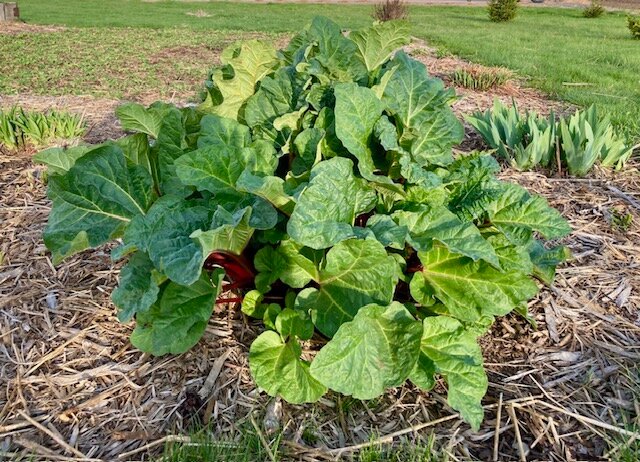

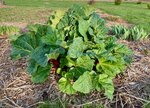
Yesterday I looked at the rhubarb in my garden and said, “Yes, it’s time to pull some.” Greg now has been treated to his first rhubarb pie of the year and won’t be at all content unless there are more to follow. He loves rhubarb so much that I have one recipe file of just rhubarb recipes. Novelist and cookbook author, Judith Fertig, wrote in her book The Memory of Lemon: “I loved rhubarb, that hardy, under appreciated garden survivor that leafed out just as the worst of winter melted away.” Rhubarb promises a growing season to come and puts a smile on a gardener’s face.
It seems that so many people raise rhubarb in Minnesota, it must be a native plant. But actually it was first grown in Asia, according to “Plant Science at the Dinner Table”, an article from Michigan State University. It has been grown in Mongolia, Siberia, and the cold regions of China for almost 5000 years, mostly for medicinal purposes. Since rhubarb does grow wild in Alaska, it possibly is a native plant there. Siberia and parts of Alaska are definitely at the same latitude.
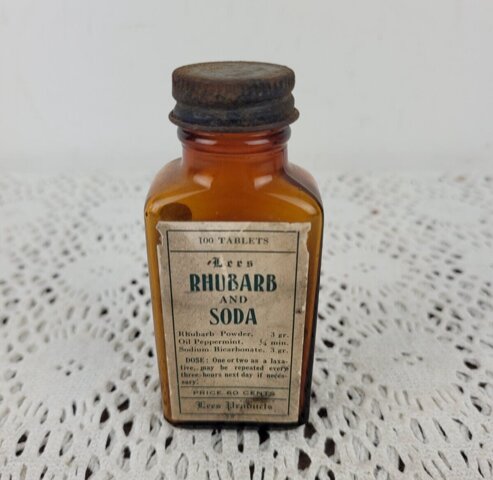
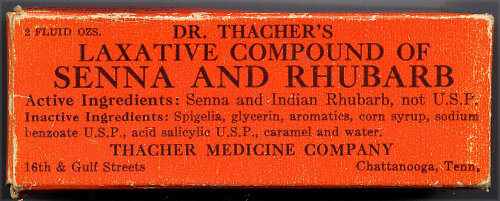
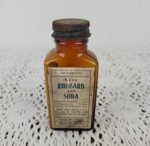
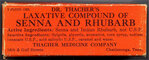
So how did rhubarb get to us in Minnesota? In the 14th century, trade over the Silk Roads brought rhubarb from Asia to Europe. Until the early 1800s rhubarb was only used for its therapeutic properties: sometimes worn as a necklace to prevent stomach cramps and aid in digestion, often used as a salve to heal wounds, and commonly used as a laxative. At the Museum we have a wonderful old book published inn 1869, Our Home Physician, written by Dr. George Beard. In the pharmaceutical section, Syrup of Rhubarb and Soda is listed as a child’s laxative. Ninety grains of powdered rhubarb,
thirty grains of sulfate of iron, forty grains of soap, and enough water to make a pill for pale and debilitated patients is another rhubarb remedy in the 1869 book. To generally feel more vigorous, this intriguing tonic was recommended: four parts sulfate of iron, ten parts extract of rhubarb, and five parts conserve of roses (rose jam). Who knew?
It took a London nurseryman, Joseph Myatt, to convince people in 1824 that rhubarb, combined with something sweet, was delicious. At the turn of the century sugar became a staple of everyday people, not just the aristocracy, so Myatt’s timing was perfect. You need sugar to enjoy rhubarb! The fact that rhubarb was a fresh food, ready before anything else in the spring garden, gave it a boost, too. In the 1700s rhubarb seeds were given to American Botanist, John Bartram in Philadelphia. Some were sent by a friend and some by none other than Ben Franklin. Bartram had great success with rhubarb and soon many in the Eastern U.S. were growing it. Rhubarb became known as the “pie plant” as it was used almost exclusively for tasty pies and tarts back then.
Rhubarb proved to be a tough, prolific plant with great survival attributes. Immigrants to the Midwest brought rhubarb roots or seeds with them from Europe and maybe that’s how I got my rhubarb. The Sathrum Farm in Ellington Township was established by my Norwegian great-grandparents in 1878. Did they bring rhubarb with them to our farm? When their rhubarb reached old age, were the seeds collected for new plants or the roots divided? During my lifetime, there’s always been rhubarb at the farm. When we built our retirement home, I dug some rhubarb roots up from the farm and planted them where I now live in Concord Township and they seem as happy as can be. Does your rhubarb have a story?
The success of rhubarb in Minnesota can’t be understated. I got out my 1968 Hegre Church Cookbook, my 1981 Berne Cookbook, and the West Concord Library’s Long Overdue Cookbook. As I paged through I compiled a list of the rhubarb recipes I found.
Here they are: rhubarb pie (straight up), rhubarb custard pie, cream rhubarb pie, rhubarb crunch, rhubarb dessert, rhubarb cake, rhubarb delight, frozen rhubarb dessert, rhubarb cobbler, rhubarb torte, rhubarb crisp, rhubarb bars, rhubarb jam, rhubarb sauce and pink rhubarb punch. I’m sure you could add more to that list. Everyone seems to have their favorite. Beyond that, there are all the other delicious recipes combining rhubarb with strawberries.
The 1950 cookbook published by the West Concord Methodist Church has a recipe called Pie Plant Pie. The recipe is credited to Deine Sheils, born in 1888, three years after her father and uncle established the second store in West Concord, a general store on the NW corner of Main and State Streets where the Veterans Memorial Park
is now. Like so many early recipes, Deine’s assumes that you would know at what temperature and how long to bake your pie and you would know what to add to egg whites to make a meringue. Here’s Deine’s Recipe:
Pie Plant Pie
1 1/2 cups diced pie plant
1 cup sugar
1 tablespoon butter
1 tablespoon flour
Yolks of 2 eggs
Pinch of Salt
Mix altogether and pour over the diced pie plant. Place in a pie crust and bake until done. Use the two egg whites for the top when pie is cool.
Some say, “Rhubarb makes life perfectly tart and sweet.” Enjoy the season!