We just spent a delightful month in warm, sunny Florida. There were so many things
I enjoyed during our stay, but none more than my daily bicycle rides in the
neighborhood. A good friend of ours loaned me a bike for the month and such fun
exploration and adventures ensued.
Any of my readers who knew my mother, know I come by my love of bike riding
naturally. My mom was not athletic by any stretch of the imagination, but she loved
adventure and getting exercise and took up bike riding in her 60’s and 70’s. My son
was blessed when my mom took him to Ireland one summer on a biking tour and
another summer to Austria. In fact, Mom took most of her grandchildren on biking
adventures: Alaska, the Black Hills, and the San Juan Islands were among them. My
mom was famous for biking with a big smile on her face.
Who doesn’t remember the day they learned to ride bicycle? My dad took me
to the hill by our pump (a hill in Elllington Township where I grew up was a slight incline),
gave me a gentle push, and told me to pedal like crazy. He was there to protect me
from a fall and help me stop. Suddenly, as a bike rider, I had more independence and I
loved it.
The bicycle craze hit America in the 1890s’. Cars for the everyday person would
not arrive until Ford’s Model T in 1908, but bicycles could provide easy mobility and
independence. It was the introduction of the safety bicycle in the 1880s’ that inspired the
bicycle movement. For the first time, a bike was available that had two equal-sized
wheels, a chain drive, a diamond frame like today’s, and air-filled rubber tires.
The first predecessor to the safety bike was the Velocipede in 1819. It had a
wooden frame, wheels shod with iron, and it was pushed by feet—no pedals. It’s easy
to see how that model could be improved upon.
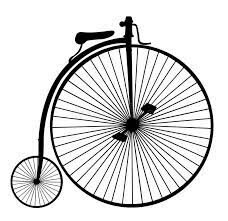
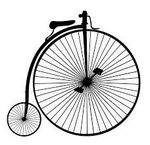
The next advance in bicycles in the 1870s’ produced the Highwheel Penny-Farthing
Bike. It was popular because it was fast, pedal driven, and metal-framed. It was also
dangerous as the rider was sitting over the large tire, 4 to 5 feet above the ground.
Accidents and broken bones were frequent. It got its name because an English penny
and a farthing coin placed side by side looked like the big and small wheels of the
Highwheel Bike.
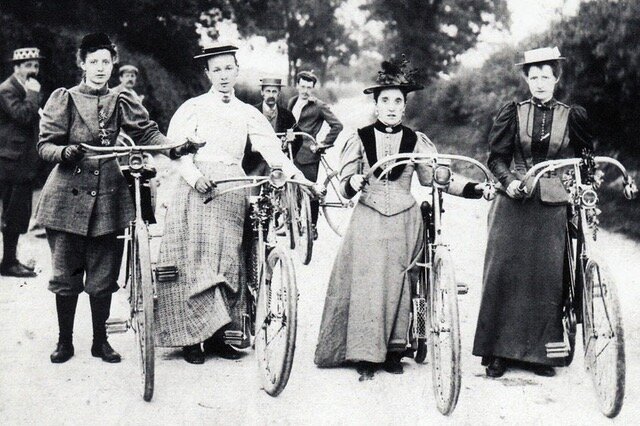
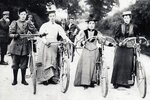
Little wonder the safety bicycle was so welcomed. For women the safety bicycle
had a drop-frame design that allowed for long skirts, but it did’t take much time before
women were looking for more comfort along with mobility. The safety bicycle allowed
them a kind of emancipation. Split skirts and shorter skirts soon became part of the
bicycle culture, as well as bloomers for the more daring. These new trends were
influential in paving the way for the flapper dresses of the early 20’s. Famous women’s
suffragist, Susan B. Anthony, said in 1896 that “the bicycle had done more to
emancipate women than anything else in the world.” That’s a powerful statement.
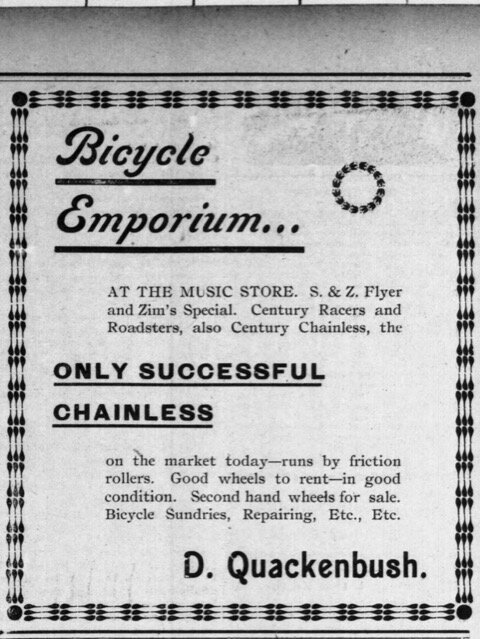
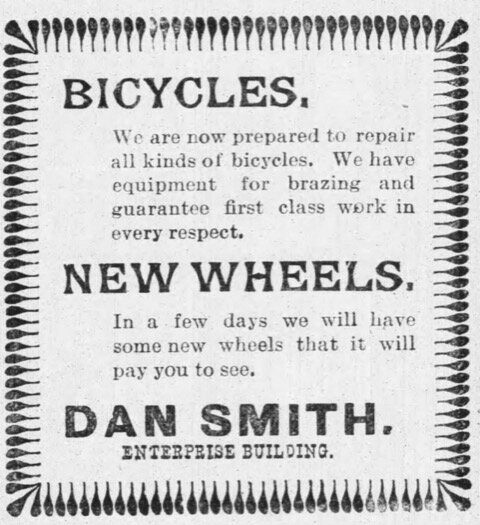
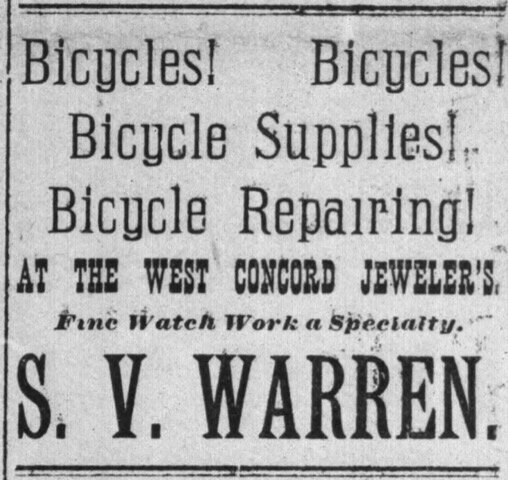
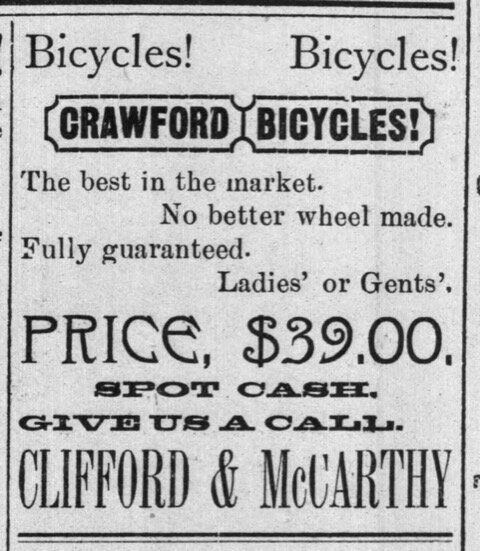
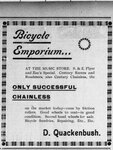
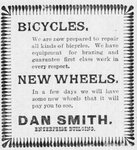
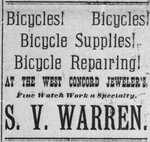
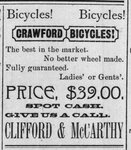
The West Concord newspapers in the 1890s’ and early 1900s’ were chock full of
bicycle ads and bicycle news. The local hardware store, jeweler, drug store and
music store all sold bicycles. You could also call the newspaper office to order a bike.
There were countless articles in the Enterprise about bicycle races and other bicycle
events happening all over America and the world.
Bicycle races and bicycle parades were both featured in West Concord’s 4th of July
celebrations as well as at the Dodge and Steele County Fairs. Sometimes the news
about bicycles was on the negative side. A syndicated article in the 1897 Enterprise
charged the bicycle with keeping people from reading. The article admonished, “So long
as it is light, every able-bodied human being is upon wheels and when they come home
they’re too tired to read.” There were also complaints that narrow bike tires were
“cutting” the roadways and destroying their surfaces. They had to be talking about dirt
roads back then.
Bikes were so popular that “bicycle slang” became part of people’s every day
language. Here are a few expressions I found in the Enterprise, which had reprinted
them from the New York Journal in October 1897:
A gossip travels with a “loose sprocket wheel”.
When a man’s sweetheart jilts him he is the victim of a “broken chain.”
A proud person, or one unduly haughty, “Rides with his handle bars raised too
high.”
The individual who shouts at night when others desire to sleep is the victim of
“loose spokes”.
If your clothes are not in style you are a ’95 model.
There must have been many bikes in West Concord because on April 27, 1905
West Concord’s first bicycle ordinance was printed in the Enterprise. The ordinance
forbade bicycles riding on the sidewalks in the village. People convicted of violating the
ordinance would be required to pay a fine of not less than a dollar and no more than ten
dollars. If the fine was not paid the offender would be jailed until costs were paid, but no
more than a 10 day jail stay. Yikes!
Jokes about biking appeared regularly in the Enterprise, too. I’ll close with this one
that certainly reflects the times of the 1890s’.
He: “I’ve bought a bicycle for two.”
She: “Oh, Jack. This is so sudden!”
He: (continuing)—“for two dollars less than the last one cost.” (wouldn’t you
know?)
Happy riding this spring!