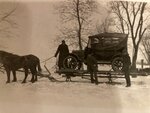
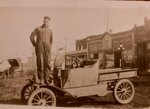
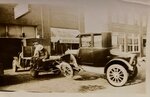
It seems that it’s often human nature to resist new technology and inventions when they’re first introduced. The old West Concord newspapers from 1892 to 1910 show that there was initially much doubt about the new “horseless carriage” era. The early newspapers of the dawning automobile age were filled with stories of accidents and deaths involving autos and many jokes about them. Here’s a sample from a November 1900 West Concord Enterprise:
A. “How did your automobile journey turn out?”
B. “Beautifully! Although I ran over two pedestrians and three bicycles and
knocked two wagons into a ditch, my motor was not at all injured and I
arrived just on time.”
And another:
Wilkins: “Smith was telling me a while ago that he really didn’t know what to
do with his income, but he is all right now.”
Watkins: “How so?”
Wilkins: “He has got an automobile.” (Sounds like today’s world!)
How about this one?
Blobbs: “Don’t you take your wife out in your auto?”
Slobbs: “I took her out once, but she screamed so every time I ran over anybody
that it made me nervous.”
Terrible jokes—but you get the picture. Automobiles were considered a menace by many at the beginning.
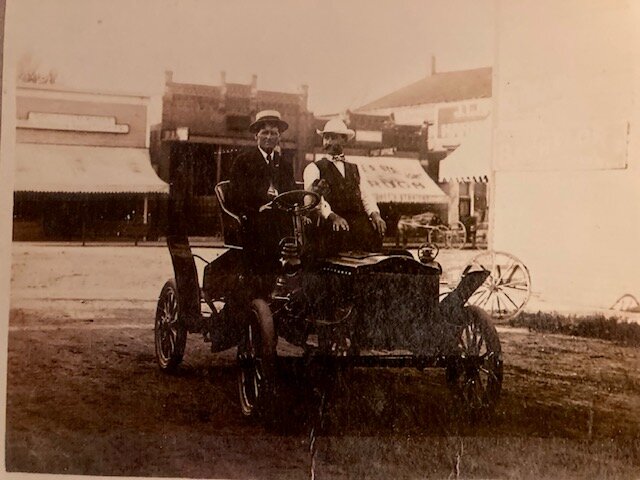
The first person to own an automobile in West Concord was Mr. W.M. Randall who in
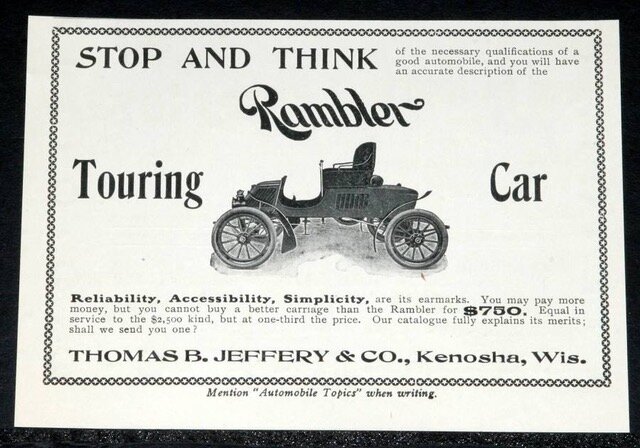
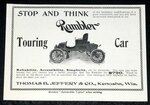
June of 1903 took the train to St. Paul and returned to West Concord in his very own automobile. The Enterprise reported that Mr. Randall’s machine was a six-horse Rambler, powered by gasoline. This automobile was made by Jeffery & Sons Co. in
Kenosha,WI—not to be confused with the AMC Rambler popular in the 50’s and 60’s. The town was so proud that the editors of the newspaper said this, “West Concord has its thumbs in the armholes of its vest, shoulders back, head erect, heels together. We’re feeling pretty well, thank you. We have a real live automobile in town!” Mr. Randall and his Rambler left St. Paul at noon, stopped at Farmington, Northfield and Dennison and arrived at Concord at 6:00 p.m. Two days later Mr. Randall devoted his Friday to giving rides to anyone who wanted one—and there were many takers. The Enterprise reported, “It is a beauty, and every man, woman and child has voted it the best ever.”
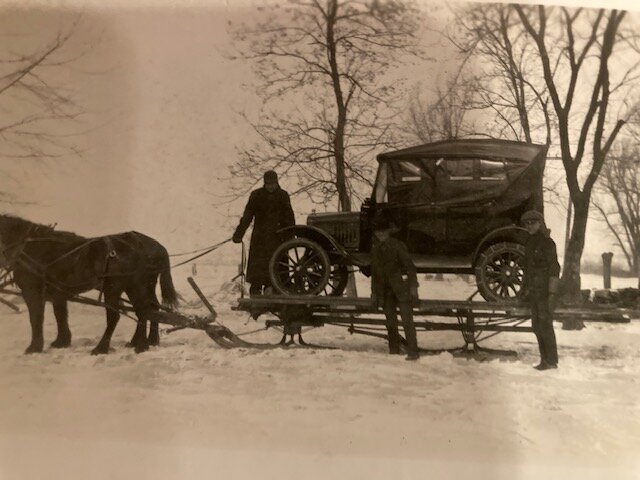
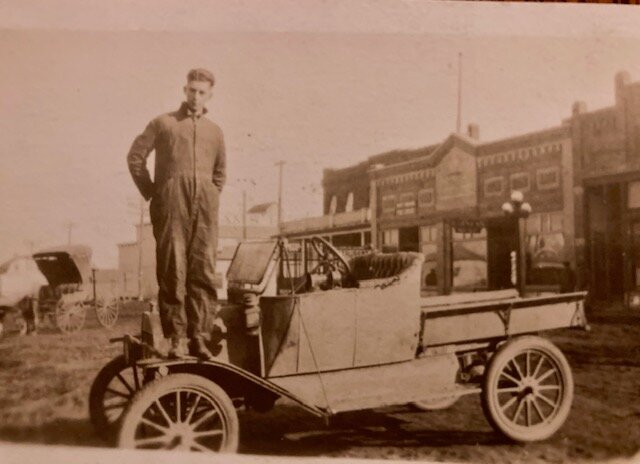
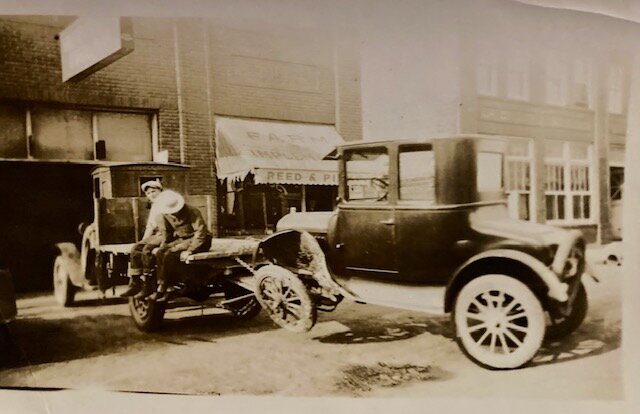
Before Ford’s Model T was introduced in 1908 cars were mostly owned by the
rich, as well as country doctors, who found them so beneficial to their practices. That was true in West Concord. Doc Clifford purchased an automobile in Minneapolis in 1906 and used it, among other travels, to take a patient to Rochester to be operated on by Dr. Mayo for cancer of the mouth.
As the Enterprise learned of new local automobile owners they each were mentioned in the weekly newspapers, as well as the trips they took away from town. Automobile ownership was really BIG news.
How were farmers feeling about the new automobile craze? Many were skeptical.
In fact, in April 1908, the anti-auto group, The Farmers’ Protective Society, a national group of concerned farmers, was featured in a tongue-in-cheek piece in the Enterprise. It was a code of 10 items, humorous, but with a pointed message. Here are just the first 5 parts of the code. I hope they make you chuckle as they did me.
1) “On discovering an approaching team of horses, the automobilist must stop off-side and cover his machine with a tarpaulin painted to correspond with the scenery.
2) The speed limit on country roads this year will be secret, and the penalty for violation will be $10 for every mile an offender is caught going in excess of it.
3) In case an automobile makes a team run away, the penalty is $50 for the first mile;$100 for the second; $200 for the third mile, etc. that the team runs, in addition to the usual damages.
4) On approaching a corner where he cannot command a view of the road ahead , the automobilist must stop not less than 100 yards from the turn, toot his horn, ring a bell, fire a revolver, and send up three bombs at intervals of five minutes.
5) Automobiles must again be seasonably painted—that is, so they will merge with the pastoral ensemble and not be startling. They must be green in the spring, golden in the summer, red in autumn, and white in winter.”
There are 5 more items in the “manifesto” but space prohibits me from including them. They would make you laugh and realize that the horseless carriages were more than a little annoying to many farmers. One example: the Enterprise reported in November of 1905 that “L.L. Woodworth lost a good horse on Saturday. He, with his wife, was returning from the funeral of the late Jacob Andrist when an automobile went past his rig. The horse became excited and reared up considerably. During the excitement it broke a blood vessel, and died shortly after.”
By 1910 the Enterprise editor proudly wrote that it was safe to say that no town West Concord’s size had as many autos. That might be hard to prove, but it meant that automobiles were becoming a part of the fabric of small town life in West Concord.
Village Ordinances were put in place to regulate them. Horseless carriages were here to stay. Tune in next month to learn more about the dawning of the automobile age in West Concord.