We have many wonderful, interesting artifacts at the Museum, but unquestionably, one of my favorites is the Quackenbush violin. It was featured in October at the Minnesota State Fiddlers Association gathering at the Museum and played and enjoyed by the fiddlers, as well as the audience. It has a story, of course, and it all began with a man named David Quackenbush.
David’s family was of Dutch descent, known as Quackenbosch in the Netherlands, and were among the early families to come to America, arriving in the mid 1600s. David was born in Rockland County, New York in 1853 and moved with his parents to Concord Township in 1856 where they were among the group of first settlers from the eastern United States. David helped on the family farm during his eight years of public education and afterward. When David’s father determined that he was old enough, he gave David 36 acres of his own to farm on the southwest corner of section 17, directly south of his father’s 80 acres. In 1874 David married Emma Carr who grew up on a nearby farm. They had a family of five children, one of whom was Ivan, the father of Marian Monical, a well-loved teacher in West Concord.
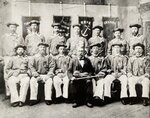
We don’t have any records telling us how David’s love of music and talent developed, but we do know that he formed the Quackenbush Orchestra in 1879. It was comprised of 4 musicians from the Concord area and later became a family group.
They were in demand all over the area. The early West Concord newspapers are sprinkled with items like this: “The Quackenbush Orchestra played for a dance in Dodge Center Friday evening.” “Thanksgiving night the Quackenbush String Band was at Zumbrota.” “The Quackenbush Orchestra was at a dance in Richland on the 4th of July.” At the Hubbell House in Mantorville is a framed invitation to a New Year’s Eve ball with music furnished by the Quackenbush String Band. They were in demand because they were good musicians. The West Concord Enterprise frequently gave glowing accounts of their playing. “There is scarcely a ball of any note in Dodge County but what it is in demand, for this orchestra is noted for its excellent playing and perfect time.” And this—“a love of dancing still lingers like a bewitching sin around old Concord, where Quackenbush & Co. played to a big crowd of happy young people.”
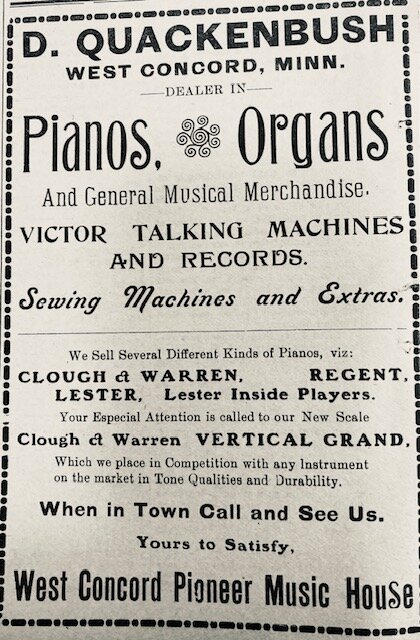
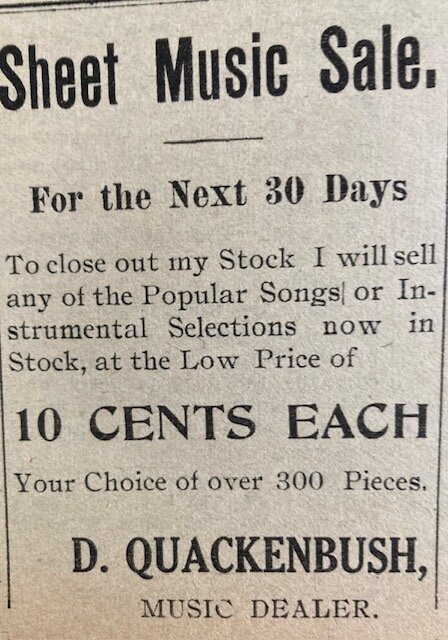
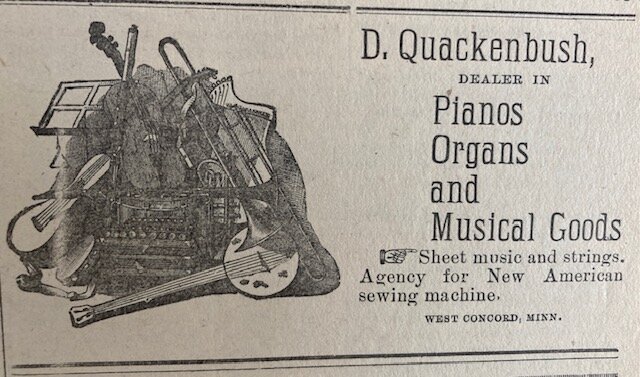
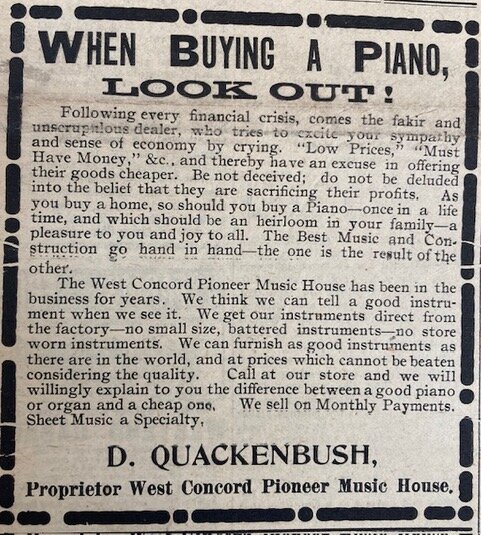
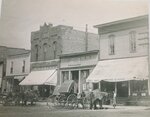
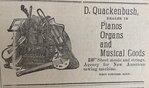
The establishment of West Concord in 1885, when the railroad came through, prompted David to engage in a new enterprise connected to music. He and M.S. Bayless started a music store in 1891 on the northwest side of Main Street. After a year David bought out his partner’s interest and operated the store until 1910.
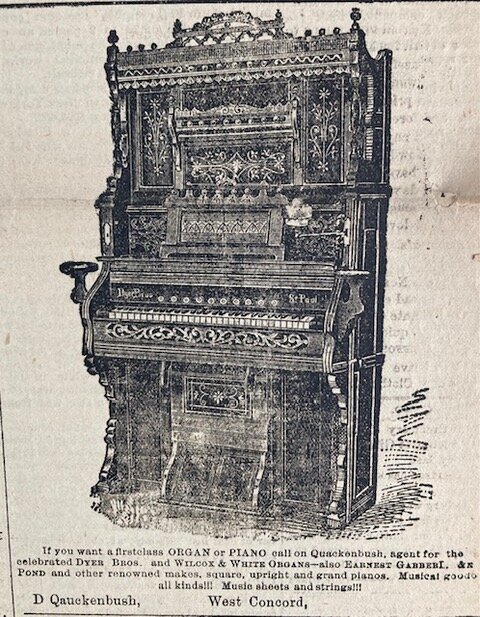
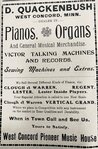
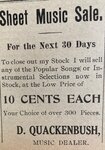
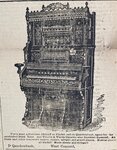
How I wish I could have visited the Quackenbush Music Store! David sold so many things that I love. His stock included sheet music, pianos, parlor organs, books, strings, Victor Talking Machines, and more. The turn of the twentieth century was the heyday of pianos and parlor organs in the home. Just think about it. When the lamps were turned on between supper and bedtime what did families do? There was no telephone, radio, or car. Often the daughters of the home played the piano or parlor organ and provided the evening’s entertainment. In 1900 there were a million pianos in American homes.
They were viewed as something of a status symbol and a sign of respectability in middle class homes. American factories were busy producing pianos in an affordable price range for the mass of buyers who wanted them. This was a promising time for a main street music store.
One of David’s sales was recorded in the Enterprise. “Dave Quackenbush has sold to Joe Erath of Skyberg, his fancy Crown organ for $125. Joe has a daisy.” “Daisy” in those days meant the cream of the crop.
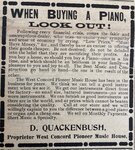
A 1904 Enterprise lauded David’s successful business by reporting, “From every nook and corner of the county, patrons come when in need of anything in the musical line whether it be a grand piano or a string.” David proved himself to be an entrepreneurial businessman. Besides musical instruments he sold sewing machines, bicycles, tuned and repaired instruments, and was a drop-off site for watch repairs.
In 1902 David reported to the West Concord Enterprise editors that he had come into possession of a “very rare old violin of the David Hopf make. The instrument shows great age, and when repaired, is worth $250.00.” You’ve perhaps guessed? That is the very violin that was given to the Museum in 1996 by David’s granddaughter. Something that adds interest and value to the instrument is that it has a label that reads “Repaired and adjusted by O.M. Robinson.” Robinson began his career as a gunmaker in New England and eventually moved to St. Paul, Minnesota where he began to make
and repair violins. David often took the train to St. Paul to replenish his stock and, no doubt, left his new acquisition with Mr. Robinson to be repaired and brought to optimal condition.
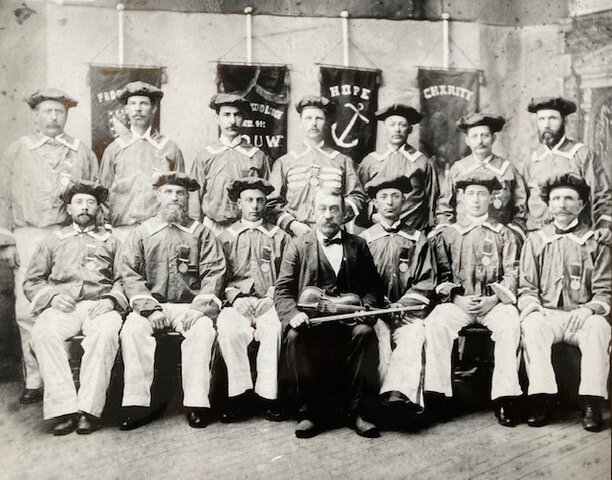
David was such an important figure in West Concord’s early life. His orchestra is listed as the music providers for many an early 20th century West Concord High School graduation. He was also postmaster in West Concord during the time of Grover Cleveland’s presidency. He served as Justice of the Peace and was director of the bands of two lodges, the Ancient Order of United Workmen and the Modern Woodmen of America. He also took time to train a “Kid” band of 15 members.
In 1910, at age 57, David sold his store and farm and he and Emma moved to a fruit farm near Corvallis, Oregon, where their daughter Jennie lived. There he was fond of taking a daily three mile walk or bike ride to the village to socialize with other residents. Sadly, David gradually lost his eyesight and developed other physical problems which led to his hospitalization in the Rochester State Hospital. He died there in 1929 at age 76. He is buried at Concord cemetery at the north end of the middle section. My “family” grows as I learn about these people who shaped West Concord’s early history. I visited David’s grave this past week and thanked him for his music.
As Maria von Trapp once said, “Music acts like a magic key, to which the most tightly closed heart opens.” Thanks, David, for joyously opening so many hearts with your music.