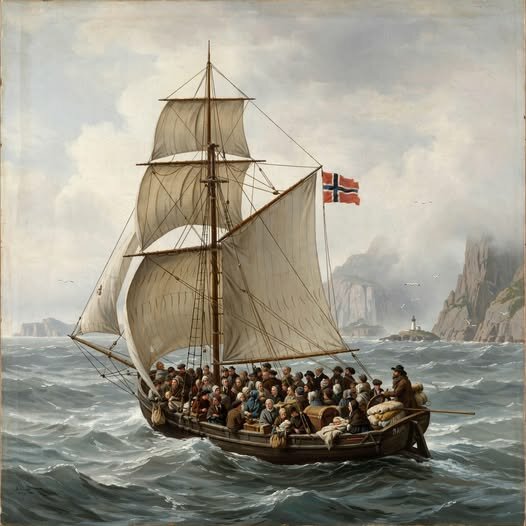
This time of year we remember the brave souls who came to this country in search of freedom in a new land. Many of us have Norwegian heritage and this is the story of the first wave of our ancestors to come to America.
July 4, 1825, Stavanger, Norway. The tiny sloop you see in this painting is Restauration. It is only 54 feet long, smaller than a modern city bus. On its deck are 52 Norwegians - 46 adults, men and women, and 8 children, the youngest just two years old. They are leaving everything they have ever known. Their houses, their farms, their families. They are carrying only wooden chests, Bibles, and hope. This is the most important ship in Norwegian-American history, and this is 100 percent real, documented in both the Norwegian National Archives in Oslo and the US National Archives in Washington D.C., with passenger manifests still preserved.
Why did they leave? In 1825, Norway was not an independent country. It was in a forced union with Sweden, poor, overpopulated, with almost no religious freedom. The leader of this group, Lars Larsen Geilane, was a Quaker, and Quakers were persecuted in Norway. The state Lutheran Church said you must be Lutheran or you will be jailed. They could not worship freely. They also heard letters from America that said there is free land, free religion, and no king.
They sold everything they owned and bought this small sloop, Restauration, which was originally built to carry only 10 people and some lumber along the Norwegian coast. It was never meant to cross the Atlantic Ocean. But they overloaded it with 52 people, barrels of water, salted fish, flatbread, and 20 Bibles. They had no navigation instruments except a simple compass and a map.
The voyage took 14 long, terrifying weeks across the Atlantic, through autumn storms that broke the mast. They had almost no privacy, everyone slept on deck. In the middle of the ocean, one baby girl was born, named Restauration and called Sara. And one man, a 60-year-old farmer named Lars Olson, died and was buried at sea. They prayed every day in Norwegian.
On October 9, 1825, after 14 weeks, they landed in New York City. They had no money, spoke no English, and looked starved. New Yorkers were shocked. The New York newspapers wrote, how did 52 people survive on a ship built for 10? The US government seized the ship because it was illegally overcrowded under US law.
But then something amazing happened. The case went to President John Quincy Adams himself. Adams, who believed in religious freedom, pardoned them, returned their ship, and allowed them to stay. He said they are pilgrims seeking liberty.
Those 52 people, called the Sloopers, did not stay in New York. They walked 350 miles to upstate New York, to Kendall, near Lake Ontario, and started the first permanent Norwegian settlement in America. They wrote letters back to Norway. The letters said, America has free land, free church, you can own 100 acres. Those letters were copied by hand and passed around villages in Norway. Those letters started a chain migration. From 1825 to 1925, exactly 100 years, over 800,000 Norwegians followed them, almost one-third of Norway's entire population at that time. It was one of the largest mass migrations in European history.
That is why October 9th, the day they landed, is now officially Leif Erikson Day in America, to honor both Leif Erikson, the first Norwegian to find America in 1000 AD, and this ship Restauration, which brought the first Norwegians to stay. Today, a perfect full-size replica of Restauration sails in the fjords of Norway as a floating museum, and the original Restauration House and cemetery is a historic museum in Kendall, New York, maintained by Norwegian-Americans.
This small 54-foot ship is the reason why today, 200 years later, 4.5 million Americans proudly say they are Norwegian-American. It all started with 52 brave, poor, religious people on a boat smaller than a bus who chose freedom over comfort.